
Making Waves in Solar: Thermal Dynamics of FPV

Making Waves in Solar: Thermal Dynamics of FPV
Other Experts:
- Updated:
Solar Panels on water? Yes, and it turns out most of them are more efficient than land-based ones, because the water and air flowing helps cool the panels. But here's the challenge nobody has fully cracked yet: how significant is this cooling effect, and how consistently does it translate into increased energy generation? This relationship between cooling and energy output is exactly what SPARKLES aims to understand. The findings are critical for determining whether FPV can transition from small-cale demonstrations to utility-scale deployment.
The problem with "just assume the wind"
Despite the growing interest in FPV systems, their thermal behaviour remains difficult to model. Most models treat wind as uniform across an installation, but in dense FPV layouts, panels obstruct and redirect airflow, creating zones with different wind speeds and temperatures. Early FPV studies adapted thermal models from land-based PV systems, however these often fail to capture the unique aerodynamics of FPV systems, where low elevation, water surroundings, and panel-to-panel sheltering fundamentally alter airflow.
A new method: CFD meets heat transfer
To address this gap, we developed a hybrid modelling approach tailored specifically to FPV systems. First, we ran large-scale computational fluid dynamics (CFD) simulations on the FPV case study site, to model how wind moves around and underneath floating panel arrays. We then extracted the wind behaviour to formulate how airflow slows down—or ‘decays’—in different parts of the system due to the sheltering effect.
These decay functions were then fed into a dynamic heat transfer model. The system was divided into multiple spatial zones, each with its own wind speed and temperature profile. This allowed the model to output three temperatures: front temperature, cell temperature (for power output), and back-panel temperature (for environmental analysis).
Key findings
When validated against real-world measurements from an installation in Drenthe, the CFD model outperforms baseline models derived from land-based PV systems, as can be seen in Figure 1.
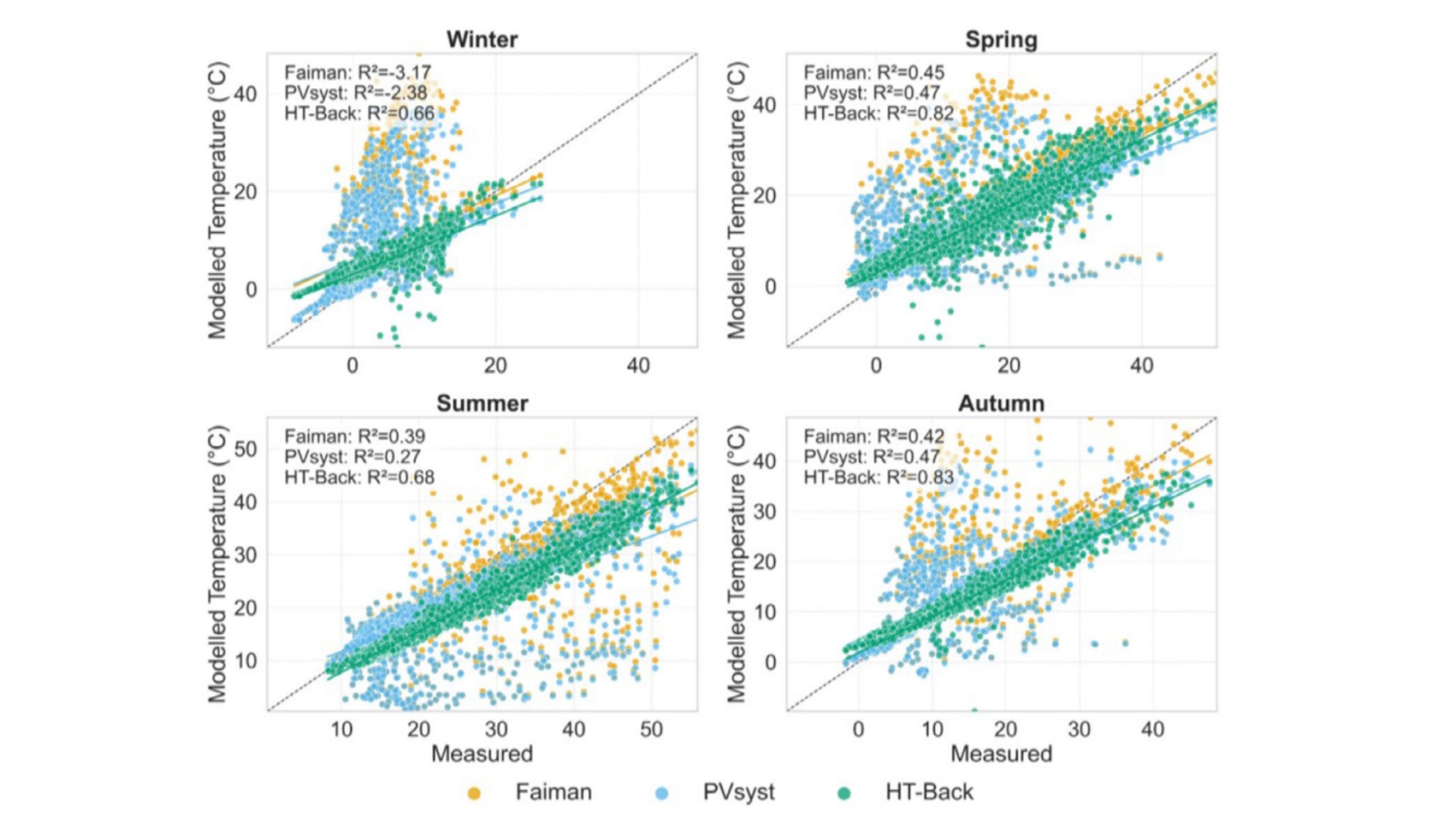
An interesting tid-bit is: the spatial variation in module temperature across a single FPV installation is significant. Panels located in sheltered interior zones run meaningfully hotter than those at the edges, which are more exposed to ambient wind. This means that a one-size-fits-all thermal model systematically misrepresents what is happening across the array—borrowed from land-based PV or not. Even advanced models must account for spatial variability to produce reliable productions.
The bigger picture: unlocking upscaling
This work addresses one piece for a larger puzzle: the need for bankable, high-fidelity performance predictions in FPV systems. By developing a method that captures spatial variations in environmental conditions and floating structures, we enable more accurate energy estimates. Crucially, this methodology provides a framework that can be applied to upscale across sites and array layouts supporting the transition for upscaling from small installations to utility-scale deployments on inland water bodies.
The next frontier is connecting this thermal framework to aquatic ecology. Shading and heat exchange affect everything from algae blooms to fish habitat. The model output of back-panel temperature already opens an important door: this output feeds directly into modelling heat exchange with the water body, making this not just an energy tool, but a basis for an ecological monitoring tool.
Future steps could include coupling panel-level thermal outputs with lake stratification models, informing smarter panel spacing that leaves ecological corridors, and building monitoring protocols in from day one.
Read the full paper
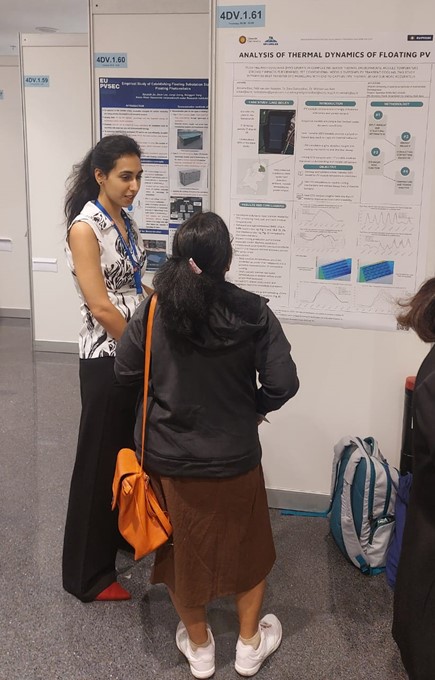
The full paper, Analysis of Thermal Dynamics of Floating Photovoltaic Systems, provides a detailed description of the methodology and results (A.Kaul, N.van den Nobelen, S.Golroodbari, W. G. J. H. M.van Sark, 2025).